
Hybrid PT Clinic Software: Cash and Insurance in One Platform
Your front desk is running two businesses. The insurance side needs eligibility checks, authorizations, claim submissions, ERA posting, denial follow-up. The cash side needs packages, memberships, auto-charges, superbills, and a friction-free checkout. Most EMRs were built for one or the other. PtEverywhere runs both engines from one database. Every encounter, regardless of how it's paid, flows through the same schedule, the same note, the same ledger.
Is This You?
- Fixed location, mixed payer mix: some in-network contracts, plus cash packages, memberships, or out-of-network services
- You're either growing the cash side of an insurance practice, or layering insurance back onto a cash-first practice
- Your front desk handles both intake paths and you can feel where the workflow breaks
- You want to know, actually know, which side of the practice is making money per visit
- You don't want to run two EMRs
What the Day Actually Looks Like
The hard part of hybrid isn't the billing. It's the operational reality of two patient paths living under one roof. A new patient calls. Are they insurance or cash? A returning patient hits their visit cap. What happens next? A cash patient asks for a superbill for one service but pays out of pocket for another. The system has to handle every branch without forcing a human to remember the rules.
PtEverywhere is built for those branches:
Full RCM, where you need it
Eligibility checks, claim submission, ERA auto-posting, denial tracking, and lag-day reporting from visit → sign-off → submission → payment. Spot bottlenecks before they hit cash flow.
Cash & memberships, where you need those
Packages, memberships, card-on-file with auto-charge, HSA/FSA support, and two-click superbills, all running from the same patient record as your insurance billing.
Automatic allocation across buckets
When a patient has a cash package AND a deductible AND a secondary payer, PtEverywhere tracks responsibility across all of them and allocates each payment to the right place. No manual reconciliation, no end-of-month surprises.
Role-based permissions that match how your team works
Therapists see clinical. Billing sees claims and AR. Owners see everything. Full audit trails on every adjustment and refund.
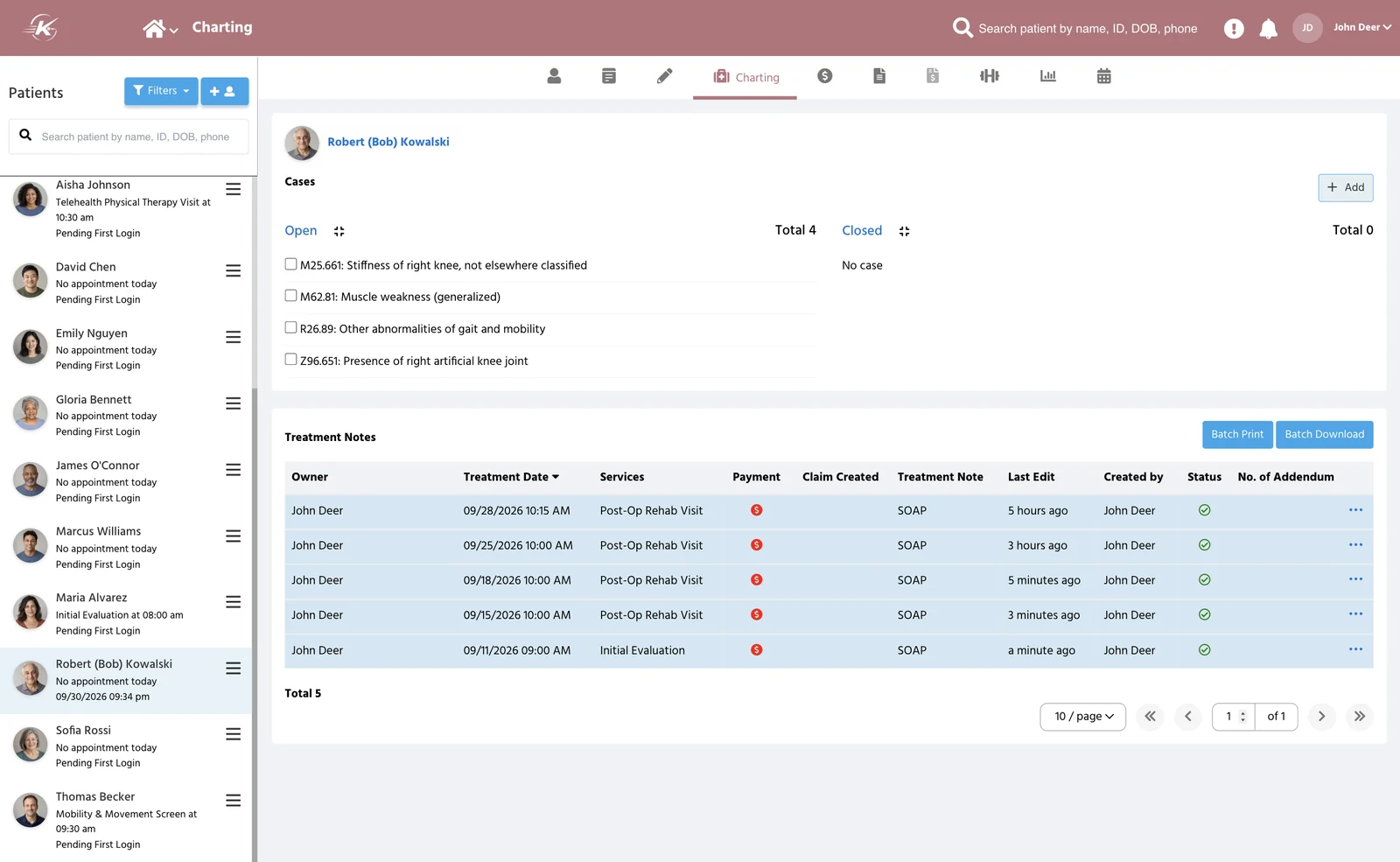
One scheduler, one note, one patient record
A therapist treating a cash patient at 10am and an in-network patient at 11am uses the same interface, the same documentation flow, the same check-in. The system handles what's different in the background.
Dashboards that show you the mix
Payer mix by location, by provider, by service. Revenue per visit on the cash side vs. the insurance side. Which payers are slow-paying and how much that's costing you. The data you need to decide where to lean.
The Question Hybrid Clinics Usually Need Answered
Which side of the practice is actually profitable?
When cash and insurance live in separate systems, that question is a quarterly spreadsheet project. When they live in one database with consistent encounter and revenue data, it's a dashboard view.
That visibility is usually what tips clinics toward hybrid software. It's less about the billing features and more about knowing what to grow.
Who Runs This Model?
The hybrid model fits mainstream orthopaedic/MSK, neurologic rehab, and pediatric clinics: practices with strong insurance contracts that are adding cash-pay wellness, performance, or membership tiers on top.
See how it fits your specialty: Orthopaedic & MSK PT · Neurologic PT · Pediatric PT
Frequently Asked Questions
Can PtEverywhere really run insurance billing and cash-pay in the same system?
Yes, that's the core design. Each encounter is tagged by payer type at scheduling. Insurance visits go through eligibility, claim submission, ERA posting, and denial management. Cash visits go through packages, card-on-file, and superbills. One schedule, one note template, one ledger.
Does the front desk need to switch between two workflows?
No. The payer type is set on the appointment; the front desk follows the same check-in flow for every patient. The system routes the billing automatically. You can also set default payer types per patient so there's nothing to remember at check-in.
How does PtEverywhere handle patients who are sometimes insurance, sometimes cash-pay?
Per-appointment payer override. Set a patient's default to insurance, but flag any specific visit as cash-pay. That's useful for cash-pay add-ons alongside insured treatment, or when a patient hits their deductible mid-year and switches to self-pay.
Do I need a separate billing service or clearinghouse?
PtEverywhere includes a built-in clearinghouse, claim scrubbing, and ERA auto-posting. You don't need a third-party biller for the insurance side. For practices that have an existing billing relationship they want to keep, PtEverywhere can also export claims.
What does switching from two separate tools look like?
Most hybrid practices are up and running within 48 hours. We import your patient records, appointment history, and open balances. Your insurance and cash workflows are configured before go-live so day one runs clean, with no dual-entry period.
Ready to see both engines running?
We'll load a realistic mixed caseload into a sandbox and walk through scheduling, charting, an in-network claim, a cash package sale, and a superbill, all against your own numbers.